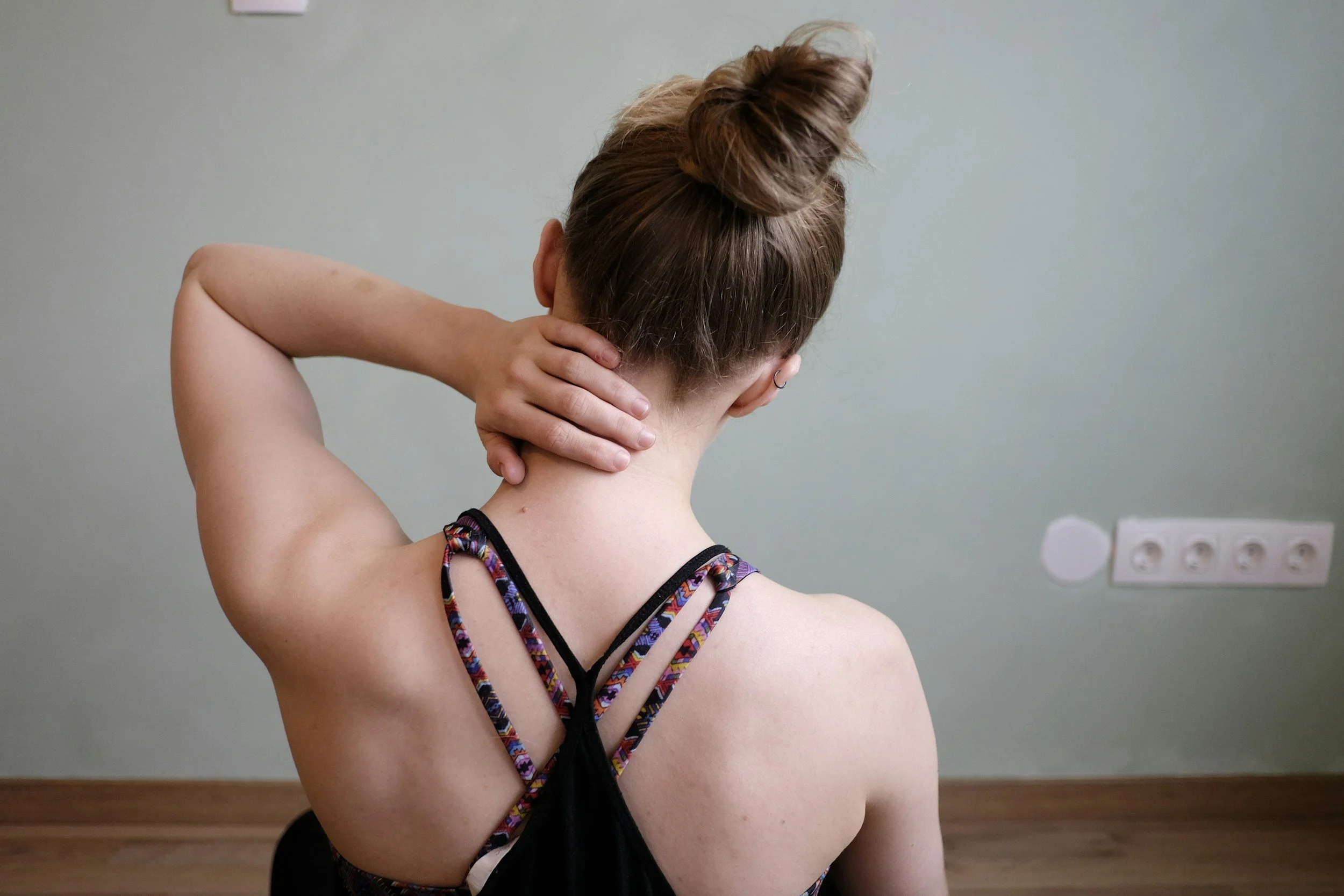
Your body holds tension because muscles tighten to protect you whenever you're under stress, and chronic stress never gives your muscles the signal to let go and soften. The bracing is protective and which eases after a short-term stressor passes, but long-term stress can keep muscles tight for weeks, months, years, or decades.
Maybe you notice the tightness at 3am when you wake-up with your jaw clenched. Or in the car, when you realize your shoulders have been up near your ears the whole drive home. You stretch, you book the massage, and two days later the tightness is back.
The body tension from stress keeps returning. The tightness in your jaw and shoulders is communicating what’s going on underneath the surface.
Why does stress cause muscle tension?
When you're stressed your nervous system is in activation mode preparing to defend itself against any threats. Stress causes muscle tension because your nervous system via the sympathetic nervous system (the fight-or-flight response) turns on, your muscles tighten like steel armor as your body prepares itself for defense. However, when the stress never ends, the fight-or-flight response stays on and your muscles never release from that clenched state. Your body stays on high alert because you are still in “do” mode. Answering emails, managing demands, driving in traffic, thinking about the argument with your boss, etc.
According to the American Psychological Association (APA), muscles that stay tight and tense for long periods of time can trigger other reactions in the body. Chronic tension in the shoulders, the neck, and the head has been linked to tension-type headaches and migraines. The APA also notes that job stress has been associated with lower back pain and neck and shoulder pain.
For a high-capacity woman who’s juggling multiple responsibilities, the stressor(s) rarely ends at 5pm. The unanswered emails and the mental to-do list follows her home. And her muscles stay on duty too. Tension that keeps returning is often a sign your body still thinks it's on watch scanning for the next threat.
What is your jaw and shoulder tension telling you?
A jaw that clenches and tight shoulders are two of the most common places stress settles in the body. These areas can reflect emotions and the effort your body has been holding without a chance for release.
In the past few years, I have been a caregiver for my dad as he’s going through his cancer journey. And the whole experience settled into my body. Late nights in emergency rooms. Multiple conversations with doctors. There was no space to feel what was happening and the emotions got postponed and stuffed down into the body. Into the muscles and the cells. My shoulders, jaw, and low back carried them instead. When there's no room to process what you're feeling, your body often holds onto your story.
How does Ayurveda explain body tension?
Ayurveda connects chronic tension to aggravated vata. Vata is the energy of movement and it’s the same energy that governs the nervous system. When vata is high, the body tends toward stiffness and a restless, anxious energy. Vata is balanced with warmth, moisture, weight, and touch. Ayurveda says we calm vata’s frenetic energy with a warm oil self-massage with a called abhyanga, regular meal times, warm, wet, and moist foods and enough periods of rest.
When the digestive fire, Agni, is weak it becomes difficult to digest our daily life experience. When your life experience moves faster than you can process those experiences, emotions pile up in the body and create tension and soreness.
Why does accepting support help your body let go?
Your body releases tension more easily when it feels supported, because muscles can stop bracing once something else holds the weight. Many women resist that support, especially if they've spent years being the capable one. The one that gets things done.
Once, I had a woman in one of my yoga classes who was resistant to using any props She became uncomfortable in a pose and didn’t want to try it. I suggested we try the pose with props first and the moment her body felt supported, the pose became possible.
Your body changes with age and life experience, and what it needs to let go changes too. As we work with tension in the body, the body needs to feel supported to facilitate release of that tension. Because the support and safety helps the body feel that it’s not alone and needs to carry everything on its own. Sometimes our internal resistance to support is information worth listening to. Telling us what ideas of ourselves we are holding onto that makes it difficult to release tension and stress in the body.
How to release tension from your body with 4 small practices
You can release body tension by giving your nervous system repeated signals of safety so it can stop bracing. Each practice below takes 60 seconds or 2-10 minutes or less. Pick one to practice daily for two weeks before adding another. Then, notice how your body feels.
1. Do a two-minute tension check at transitions
When you sit down in the car or close your laptop, scan three places: your jaw, your shoulders, and your belly. Let your teeth part slightly and rest your tongue on the floor of your mouth. Drop your shoulders and soften your belly on the exhale.
2. Lengthen your exhale
Breathe in for a count of four and out for a count of six, for about two minutes. A longer exhale is one of the simplest ways to cue your parasympathetic, or "rest and digest," nervous system. It's easy to do between meetings with no one noticing.
3. Rest in a supported pose with pillows and blankets
Lie in supported child's pose over a stack of pillows, or lay down with a pillow under your knees and a blanket under your head. Rest there for 2,5, or 10 minutes. Allow the floor and the pillows to hold you and release into the support knowing there is nothing for you to carry.
4. Try a five-minute warm oil self-massage
Before your shower, warm a little sesame, almond oil, jojoba oil, or any oil you have on hand. Massage it into your neck, shoulders, arms, and legs with long, slow strokes. This self-massage is a practice that calms the nervous system and helps release tension in the body. for you.
Frequently asked questions about body tension from stress
Can stress cause muscle pain?
Yes. Stress tightens muscles as a protective reflex, and chronic stress can keep them tight for long periods. The American Psychological Association links ongoing muscle tension to tension-type headaches, migraines, and neck and shoulder pain, and notes that job stress has been associated with low back and upper limb pain.
Why do I clench my jaw when I'm stressed?
Jaw clenching is one of the most common ways the body braces under stress. A 2020 systematic review in Frontiers in Neurology found that people under stress had about twice the odds of bruxism, or clenching and grinding.
Can your body hold emotions?
Emotions show up in the body as physical sensations, and when stress and feelings go unprocessed, many people notice tension in the jaw, shoulders, chest, or gut. Practices that combine breath, gentle movement, and rest can help your body move through what it has been holding.
Does yoga help with body tension?
Yoga can help, especially gentle and restorative styles. A 2019 meta-analysis of 10 trials with 686 participants found that yoga reduced chronic neck pain and related disability and improved mood.
Your body has been holding a lot
Tension that won't leave is your body doing its job for longer than it was built to. With support and small daily signals of safety, it can learn to put some of that weight down.
If you'd like guided practice, the Body Rhythm Yoga Membership gives you two live classes a week, a library of restorative practices, and monthly group coaching for women carrying too much. [OFFER LINK: Body Rhythm Yoga Membership page (URL needed) | "Join the Body Rhythm Yoga Membership"]
Not ready to join? Start with my free Deep Rest Yoga Nidra practice, a guided rest you can do lying down tonight.
If your tests come back normal and you still don't feel like yourself, you don't have to figure it out alone. Book a free 30-minute Embodied Wisdom Session and we'll look at what your body needs.