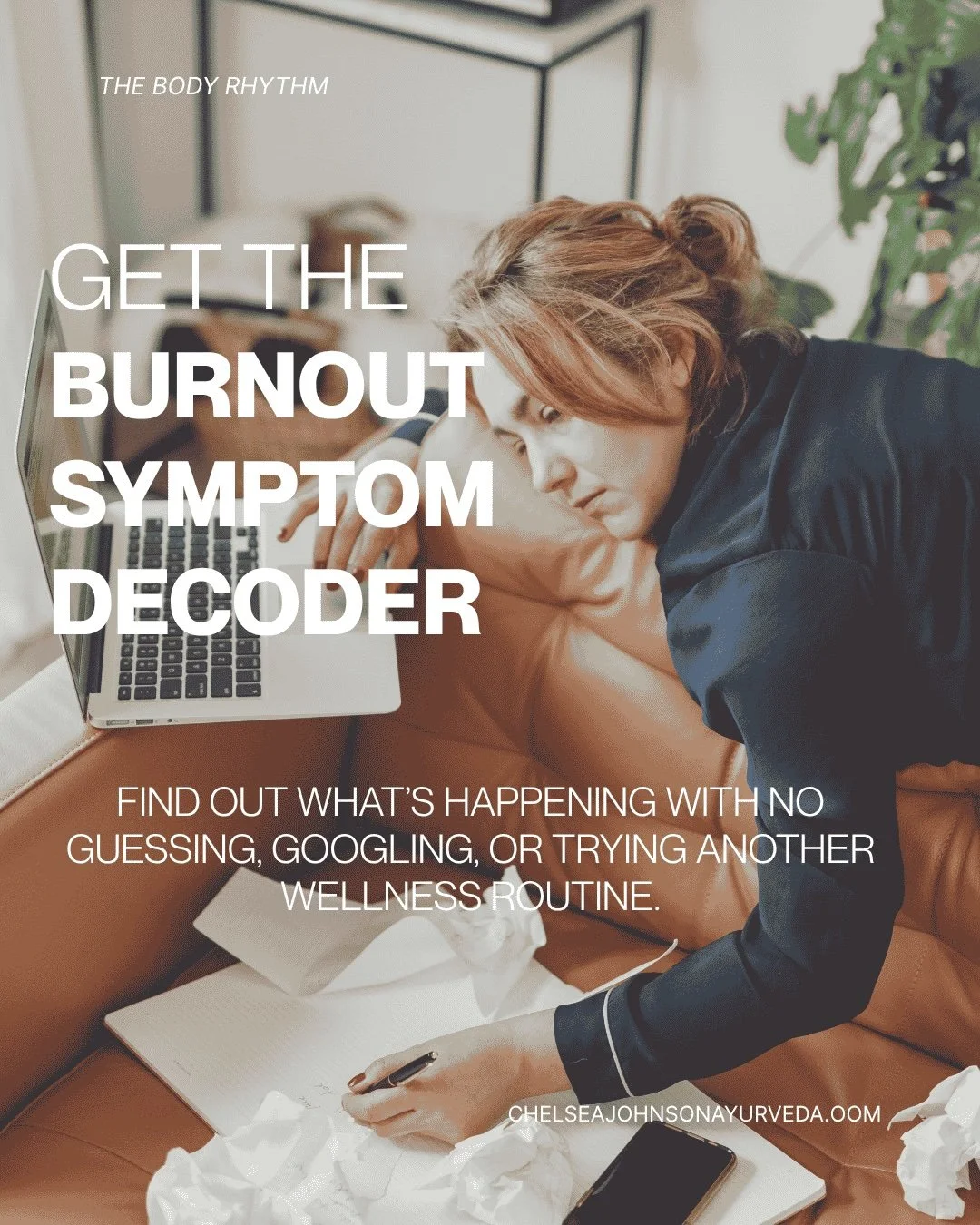
Sometimes the most telling moment in a session with a client isn’t what the client says. It's what happens when she finally has the space to pause and she stops talking.
I've watched it happen numerous times. A woman sits down for her first intake session — competent, composed, holding it together the way she always does. We talk through her symptoms. Her sleep, her digestion, her energy. And then, in the middle of an ordinary sentence, something shifts. Her breath catches. Her eyes fill.
And she apologizes. "I'm sorry, I don't know why I'm crying."
You're not crying because something is wrong. You're crying because your body finally feels safe.
That moment of unexpected release is one of the most important things that can happen in the healing process. It means the body has been waiting for a moment like this. A pause, a time to rest, a place to feel safe and supported.
What "I Feel Anxious, Sluggish, Sick, Exhausted" Is Actually Telling You
If you've been Googling some version of I feel anxious, I feel sluggish, I feel sick, I don't know what I'm experiencing, you’re not experiencing random symptoms. It’s a sign that your body has accumulated more than it has been able to process.
The vague unease, the heaviness, the low-grade anxiety, the inability to sleep well, the exhaustion that isn't explained by how much or little you've slept are all symptoms that tell you the body is trying to move through something. In Ayurveda, this residue of unprocessed experience is called Ama. Emotional ama is the accumulation of every life experience that your body’ hasn’t been able to fully metabolize. It’s an emotional toxic buildup of stress, grief, and the weight of holding things in for years as every experience gets pushed down into the cellular level.
Your body is trying to process experiences that your stress response has interrupted.
Why High-Capacity Women Can't Cry Even When They Need To
A while back I was watching a trailer recently for a movie featuring a woman in full command. She was strong, capable and kicking ass at every turn. And it struck me, not because female strength isn't real or valuable, but because I couldn't remember the last time I saw a film celebrate the other things women carry. The nurturing. The softness. The willingness to turn toward someone in their grief and say “I got you. I'll care of you.”
I heard those exact words described at a talk I attended at the Holocaust Museum in Los Angeles. A Holocaust survivor described being eight years old at the time and shared how she and her mother were forced on a march from Hungary to Germany. Her mother was taken and shot during that march. A woman she barely knew stepped forward and told her to come sleep with her and that she would care for her now that her mother was gone. Once at the camp, other women offered the same care for this motherless girl. At the end of the war when she was liberated, she was brought to Sweden and another woman became like a second mother to her. Love in it’s most embodied form allowed this girl to survive the unsurvivable. These are the important qualities that women only possess.
The qualities of nurturing, compassion, love, and the willingness to soften toward another person are the same qualities that our culture has told women to put away as not as valuable in their life experience. And so women learn to lead with capability and suppress everything that feels too slow, too tender, too much.
Emotional release experienced as crying, trembling, the involuntary sigh that comes when something finally gives requires your nervous system to feel safe enough and supported enough to let go. For women who have spent years being the regulated one, the calm one, the one who holds the room together at the cost of their own nervous system, that felt-sense of safety is often the most elusive thing in their lives.
High-functioning anxiety - the pattern of appearing capable and composed while internally running on hypervigilance and suppressed stress — is extraordinarily common in the women I work with. The body stores what the mind can’t process. Your system that is never permitted to release eventually communicates through symptoms. Research is also starting to support what Ayurveda has known for thousands of years. When you don’t get enough sleep your brain can’t get rid of toxins effectively which impacts your mood and your life experience.
When emotions are consistently overridden because there's no time, because others need you, because falling apart is a luxury you can't afford, the nervous system stays locked in sympathetic activation. Sympathetic activation, also called the fight or flight response, is a nervous system state that keeps your body braced and in a state of alertness. While in this braced nervous system state, your body can’t cry, soften, or release because your nervous system believes the threat still lingers and has to protect you against harm. And for many women, and men, the nervous system has been in this braced response for months, years, or decades.
What Actually Happens in Your Body When You Finally Release Stress
Emotional release is a physiological release. It activates the parasympathetic nervous system, also called the rest-and-digest response, through the vagal nerve. The vagal nerve is the long cranial nerve that runs from the brainstem, through the heart and lungs, to the digestive organs. When the vagus nerve is activated, heart rate slows, breathing deepens, and the body begins to shift from survival mode into restoration.
Tears are not simply emotional. Emotional tears contain stress hormones. The act of crying is a literal excretion of stress chemistry from the body. When a woman cries in session and says she feels lighter afterward, she isn't imagining it. Her body has chemically changed.
Emotion is movement. Tears are movement. Anger is movement. The long exhale, the trembling in the hands, the involuntary sob, all of it is the body completing a physiological process that the stress response interrupted. When emotion moves, the rib cage begins to open. The heart lifts. The tissue of the lungs expands. What Ayurveda calls Ama — the toxic residue of what hasn't been processed begins to release from the tissues. The body knows exactly how to heal. And for a woman who has been bracing, or in a state of rigidity for along time, emotional movement can feel scary.
The Body Holds What the Mind Cannot Process
I’ve been in a season of caregiving for my father through his cancer diagnosis and treatment. I’ve been in and out of emergency rooms, doctor’s appointment, managing care and logistics, translating medical information, and trying to hold myself together. Sometimes, when we are in the thick of caregiving or functioning through the day, there is no time to feel what your feeling. So the body takes it and buries it. The emotions get filed for later. And later comes when we least want it to.
What happens in a sustained crisis — and burnout is a sustained crisis, even when it looks like an ordinary Tuesday — is that the emotional content of the experience gets stored in the body's tissues because the nervous system has no safe moment to process and release it. In the language of somatic psychology, this is called incomplete stress cycles — the body mobilizes to respond to a threat, but the resolution never comes, so the activation remains stored in the musculature, the breath, the gut. Ayurveda has known this for thousands of years but the ancients didn’t have the language for somatics. They had the language of imbalance and how symptoms showed up in the body, mind, breath, and spirit.
Burnout disconnects women from joy in exactly this way. In nine out of ten sessions with a deeply burned-out woman, when I ask at the end what brings her joy, the answer is some version of "I don't know anymore." Joy doesn't disappear. It becomes inaccessible when the nervous system is too full of unprocessed experience to feel anything.
Emotional health isn’t the absence of hard feelings. It’s the ability to feel them without being permanently swallowed by them. When the emotional body is healthy, we can feel sadness, grief, and anger, and those feelings move through us rather than staying. We don't dwell in the same emotional state for weeks. We feel, we process, and we come back to center. That capacity is what builds resilience. It’s not the ability to never fall, but it’s ability to recover faster when we do. Our emotional experience becomes more pliable and it’s easier to return to homeostasis.
How to Create the Conditions for Your Body to Unravel Safely
Release doesn't happen on command. It happens when the nervous system receives enough signals of safety to lower its guard. The work is not to force emotion out — it's to create the environment where it can finally move.
Slow the breath before anything else. A long exhale which is longer than the inhale activates the vagus nerve and begins shifting the autonomic nervous system toward parasympathetic dominance. Four counts in, 5 counts out. Perhaps it’s one count in, and two counts out. Start where it feels comfortable. This is the most direct route to nervous system softening that exists.
Move slowly and with awareness. Gentle, conscious movement such as restorative yoga, slow walking, stretching with attention to sensation gives the body a way to process what the mind has been carrying.
Remove yourself from the role long enough to feel. Release rarely happens while you are still in performance mode. The woman who cries in the car after work is not weak — she has finally stepped out of her role long enough for her body to tell her the truth. Building even small moments of pause into your day begins to create an opening to release emotion. No phone, no tasks, no distraction for even 60 seconds can be a starting point.
Ask yourself one honest question. A useful place to begin exploring the emotional body is beginning to ask yourself what have you not been wanting to feel. Simply acknowledging what is there. If it’s been sitting for a long time this can begin to move something from the sub-conscious to the conscious.
Add pranayama (conscious breathing) to your daily practice. Prana is the life force that gives us life. It animates our body before the breath arrives. Prana has the power to move what is stuck and what willpower and logic cannot touch. I learned this firsthand about ten years ago when I was at a yoga retreat in Spain. I had been suffering from sciatica for weeks before I left for the trip. I had done yoga poses, stretching, walking, everything I could think of and it didn’t disappear. The doctor wanted to put me on strong painkillers and I said no. The breathwork facilitator told me to do the breathwork sessions and the pain would disappear. I looked at her as if she was crazy. Curious, I did three or four breathwork sessions anyway. The sciatica disappeared. In fact, the sciatica disappeared for over a year before stress brought it back. What breath work reached everything else had missed. That is prana moving through the tissues. That is emotion finally finding a way out. That breath can help us release what we don’t even realize is there.
Let yourself dance. This sounds simple and it is. Put on music that you love and move your body in a way that feels good. is one of the fastest ways to shift the nervous system out of contraction. Movement is the language the body speaks. Dancing can begin to move the rigidity out of the tissues and the pelvic bowl where many women store emotions.
Let the body lead, not the mind. Healing through emotional release is not intellectual work. It does not require understanding why you feel what you feel before you feel it. The body often knows what it needs to release long before the mind catches up. Your job is to create the space and then get out of the way.
What Yoga Nidra Does That Other Practices Can't
Yoga Nidra is the ancient practice of guided yogic sleep. It’sa systematic technique for bringing the body into a deep state of rest while maintaining conscious awareness, although many people do fall asleep. Yoga Nidra is an effective tool for creating the conditions necessary for the body to release what it has been holding.
Women describe the practice as the first time in years they've felt genuinely held rather than holding. Some cry. Some feel the involuntary release of a long exhale they didn't know they'd been suppressing. Some simply fall asleep.
FAQs: Releasing Stress From Your Body
Q: Why do I cry for no reason when I finally rest or slow down? This is one of the most common experiences in burnout recovery. When the nervous system finally receives enough safety signals to soften, stored emotional content begins to move through. Crying when you rest isn't a sign something is wrong. It's a sign something is finally safe enough to release.
Q: Why do I feel anxious even when nothing is wrong? Free-floating anxiety with no specific cause is often the body's stress physiology running in the background. When the HPA axis — the hormonal stress-response system, is chronically activated by burnout, the feeling of threat can persist even when your external circumstances are calm.
Q: What is somatic release and is it safe? Somatic release refers to the discharge of stress stored in the body's tissues — through trembling, crying, deep exhales, spontaneous movement, or other physiological responses. It is a normal, healthy process that the body initiates when the nervous system feels safe enough. For most people, somatic release is gentle and gradual. If you have a trauma history that involves physical symptoms being activated, somatic body-based practices can be very helpful.
Q: How does Yoga Nidra help with emotional release? Yoga Nidra brings the body into a state similar to sleep. This is when the nervous system shifts to the rest-and-digest response. Yoga Nidra bypasses the mind’s effort and control to create a state in which the mind, body, and soul can soften.
Q: How long does it take to feel better after starting to release stored stress? Most women notice a shift more ease in the body, slightly quieter anxiety, deeper sleep — within 30 days of consistent nervous system support. Full release of long-held patterns takes longer and isn't linear. Expect waves of periods of greater openness followed by periods of protection. That rhythm is the nervous system working correctly.
Your Body Has Been Waiting for This
The anxiety, the sluggishness, the exhaustion that doesn't lift, the unnamed heaviness are signs that your body is carrying more than it should have to carry alone.
You don't have to earn rest. You just have to create the conditions and let the body do what it has always known how to do. Tonight is as good a time as any to begin.
Download the Yoga Nidra Practice — Use It Tonight
This is a guided practice designed specifically for the kind of tired that sleep doesn't fix — the nervous system depletion that lives underneath a life of high output and holding too much. Lie down. Press play. Let your body finally do what it's been waiting to do. No effort required.
Last updated August 2026