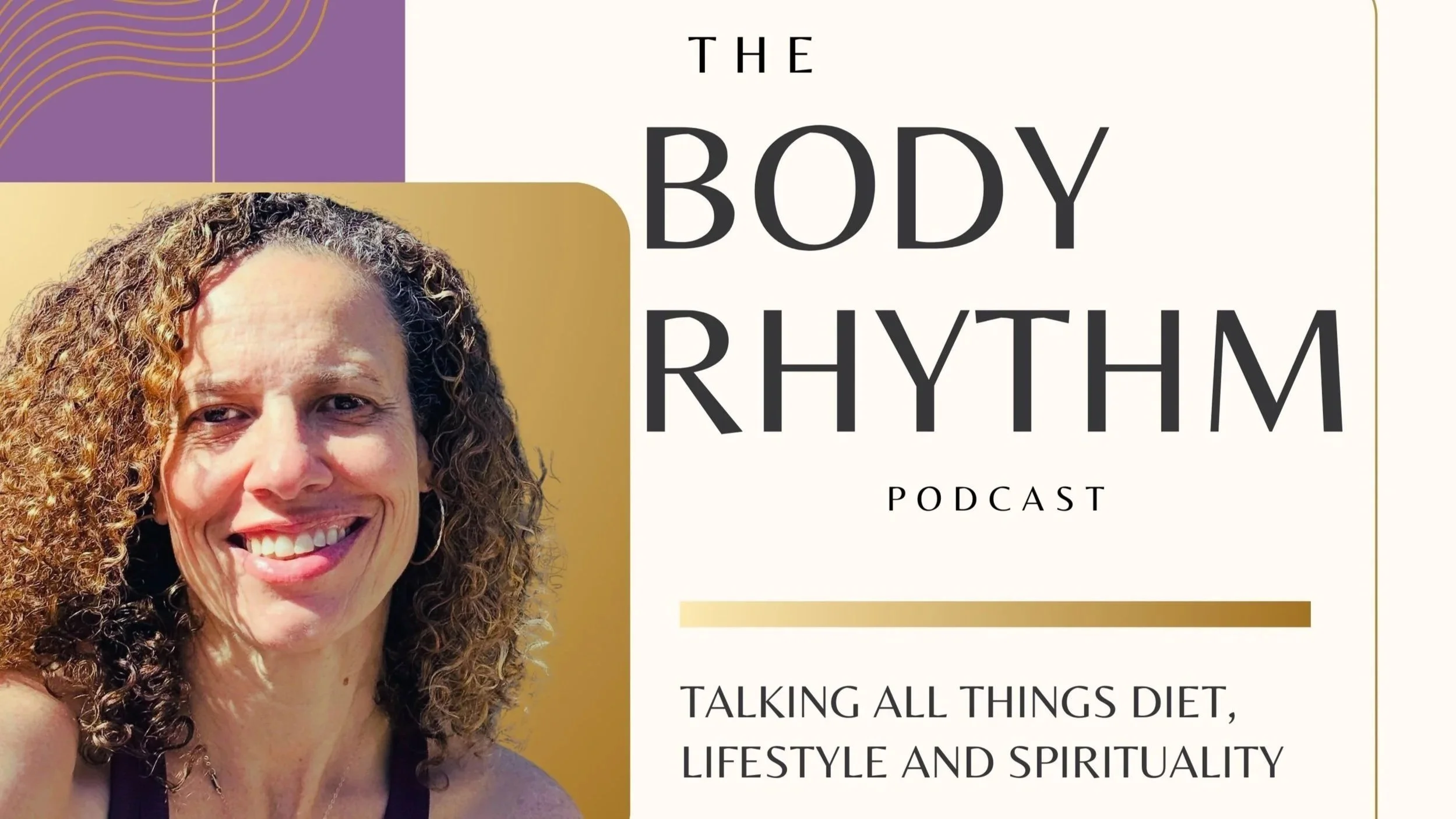
The Body Rhythm Podcast
with Chelsea Johnson
The Body Rhythm is a podcast for women who are doing everything right and still feel like something's off. Each episode blends Ayurvedic wisdom with nervous system science to help you understand why your body feels exhausted, wired, or stuck — and what to actually do about it.
Whether you're dealing with burnout, digestive issues, hormonal imbalance, or just a persistent feeling that you've lost your rhythm, you're in the right place.
New episodes Thursday.
Not sure where to start? Take the free gut health quiz and find your pattern →
Start Here
Most Recent Episodes
Bloated and Tired? You’re Not Broken—Your Body Is Overwhelmed | Episode 25
If your digestion is off, your energy keeps crashing, and you feel like you're constantly about to get sick — that's not three separate problems. It's one pattern showing up in different ways.
When your body feels off in multiple places at once, it's easy to feel like everything is breaking down. You see one doctor for digestion, another for fatigue, another for immunity — and nothing quite connects. In this episode of The Body Rhythm podcast, we explore why bloating, exhaustion, and a weakened immune system are often the same imbalance speaking different languages, and what your body is actually trying to tell you.
What you'll take away from this episode:
Your body isn't breaking down — it's responding. Bloating, afternoon energy crashes, getting run down easily — these aren't separate fires to put out. They're one system under pressure, communicating the same message through different symptoms.
A large part of your immune system lives in your gut. When digestion is off, inflammation rises. When inflammation rises, energy drops. When energy drops, everything feels harder. These systems are constantly influencing each other — which means supporting one begins to support them all.
Stress is the thread connecting everything. When your nervous system stays activated, digestion slows, immunity weakens, energy becomes unpredictable, and repair gets deprioritized. It's not a discipline problem. It's a capacity problem — your body is managing more than it has the resources to handle.
Ayurveda has understood this for over 5,000 years. Digestion, immunity, energy, and emotional wellbeing were never seen as separate. They are reflections of the same internal state — how well your body is processing what it receives, and how safe it feels doing it.
The shift isn't more effort — it's more rhythm. Eating without your phone, stepping outside for a few minutes of natural light, breathing before meals — these small consistent signals tell your nervous system it's safe to rest and digest. When the system feels supported, symptoms begin to ease without fixing each one separately.
The question isn't what is wrong with me. It's what is my body trying to tell me — and what does it need more of right now?
Read this week's full post → The Body Rhythm Blog
Every week in The Body Rhythm newsletter I share one practice, one reframe, and one small thing your nervous system actually needs. If this resonated, you'll feel at home there.
Join the newsletter → Here
Breathing for Anxiety Isn’t Working? Here’s Why | Episode 24
If deep breathing feels stuck, forced, or like it just doesn't help — that's not a breathing problem. It's your nervous system telling you something important.
You've been told to just take a deep breath. Maybe you've tried. Maybe it helped for a moment, or maybe it didn't help at all — and you wondered what was wrong with you. In this episode of The Body Rhythm podcast, we explore why breathing techniques don't always work, what your breath is actually telling you about your nervous system, and what to do instead when the standard advice falls short.
What you'll take away from this episode:
Shallow or stuck breathing isn't a habit problem — it's a stress response. When your body has been bracing, holding, and staying alert for a long time, the breath is one of the first places that tension lives. You didn't forget to breathe. Your body has been responding to everything it's been carrying.
The diaphragm is more powerful than most people realize. Every full, free breath massages your internal organs, stimulates your vagus nerve, supports digestion, and signals your nervous system that it's safe to soften. One muscle, one movement — with the ability to shift your entire physiology.
Not all breathing techniques are right for every body. Heating practices like ocean breath or bellows breath can actually intensify stress in an already overwhelmed system. The breath has to counter what's happening in your body to be truly healing — not add more intensity to a fire that's already burning.
If deep inhales feel forced, start with the exhale. Lengthening the exhale just a little longer than the inhale is one of the simplest and most effective ways to begin shifting your nervous system out of fight-or-flight. You don't need a technique. You need a signal that it's safe to let go.
Physical support changes everything. A pillow under your knees, a blanket across your chest, something soft under your head — these aren't just comfort measures. They teach your body that it doesn't have to hold everything on its own. When the body feels supported, the breath begins to soften naturally.
Your breath isn't broken. It's one of the most honest signals your body has — and learning to listen to it rather than override it is one of the most powerful things you can do for your nervous system.
Read this week's full post → The Body Rhythm Blog
Every week in The Body Rhythm newsletter I share one practice, one reframe, and one small thing your nervous system actually needs. If this resonated, you'll feel at home there.
Join the newsletter → Here
Burnt Out But Still Pushing Through? Why You Feel Drained | Episode 23
Burnt Out? It's Not About Doing Too Much — It's About This | The Body Rhythm
If you're exhausted but still functioning, still showing up, still holding it all together — this isn't a discipline problem. It's something your nervous system has been carrying for a very long time.
There's a specific kind of exhaustion where even small things feel heavy. You get through the day, you do what needs to be done, and then you lie down at night with your mind still running. You wonder what's wrong with you. In this episode of The Body Rhythm podcast, we explore why burnout isn't about how much you're doing — it's about how long your body has been carrying it without rhythm, without recovery, and without enough support.
What you'll take away from this episode:
Burnout isn't a mindset issue — it's a physiological load issue. Telling yourself to be more consistent or more disciplined misses what's actually happening. Your body has been in survival mode so long it doesn't know how to fully rest anymore — even when you stop.
Your symptoms are not random. The bloating that comes out of nowhere, the tension in your neck and shoulders that never fully releases, the 3am waking with your jaw already clenched — these are your nervous system trying to get your attention the only way it knows how.
Burnout disconnects you from joy. When women are deeply burnt out, the answer to "what brings you joy?" is often "I don't know" or "I used to love that but not anymore." That's not a personality shift. That's a nervous system that's been in survival mode for too long.
Rest alone doesn't work when the body is still in survival mode. Sleep and breaks help, but if your stress response is still quietly running underneath, you're just pausing inside survival mode — not truly restoring. That's why you can sleep eight hours and still wake up exhausted.
Rhythm is where restoration begins. Not a life overhaul. Not more rules. Consistent mealtimes, one small morning anchor, five minutes without your phone before bed — these gentle, repeated signals teach your nervous system that it's safe to slow down, safe to receive, safe to stop bracing.
Burnout isn't your identity. It's your body asking for a different way of being — not more pressure, but a return to the rhythm it's been missing.
Read this week's full post → The Body Rhythm Blog
Every week in The Body Rhythm newsletter I share one practice, one reframe, and one small thing your nervous system actually needs. If this resonated, you'll feel at home there.
Join the newsletter → Here
Always Inflamed? Why Your Body Feels This Way — And What's Actually Behind It | Episode 22
Bloated, foggy, and reactive even when you're eating clean? Inflammation might not be the problem — it might be the message. And there's an important difference.
If you've been cutting foods, adding supplements, and doing everything right — and your body still feels off — you are not doing anything wrong. In this episode of The Body Rhythm podcast, we explore why inflammation isn't the enemy your body is fighting, but a signal it's been sending for a long time. Understanding the difference changes everything about how you support yourself.
What you'll take away from this episode:
Inflammation is a symptom, not the root cause. Your body isn't breaking down — it's adapting to what it's been carrying. Bloating, brain fog, joint stiffness, and skin flare-ups are the body's way of communicating that something deeper needs attention.
Chronic stress is one of the biggest drivers. When your nervous system stays in a low-level stress response — even the quiet, invisible kind — digestion slows, repair decreases, and inflammation increases. Not because something is wrong with you, but because your body is prioritizing survival over restoration.
Ayurveda starts with digestion, not inflammation. When your digestive fire weakens through stress, irregular rhythms, and depletion, what doesn't get fully processed begins to accumulate. In Ayurveda this is called ama — and over time, that accumulation creates the conditions for inflammation. Inflammation is where we finally notice it. The root started much earlier.
Restriction and elimination address the symptom, not the system. Cutting gluten, dairy, or following anti-inflammatory protocols can bring relief — but if the approach doesn't ask why the body became reactive in the first place, the pattern keeps returning.
Your body responds to support, not more pressure. More rules layered on top of an already depleted system rarely create lasting change. What your body is actually asking for is rhythm, safety, and the conditions that allow it to finally process and clear what it no longer needs.
The question isn't how do I get rid of inflammation? It's what has my body been needing that it hasn't been receiving? That shift alone changes everything about where you look — and what you find.
Read this week's full post → The Body Rhythm Blog
Every week in The Body Rhythm newsletter I share one practice, one reframe, and one small thing your nervous system actually needs. If this resonated, you'll feel at home there.
Join the newsletter → Here
Wake Up Anxious at 2–3AM? It’s Not Insomnia—It’s Your Nervous System | Episode 21
Why You Keep Waking Up at 2 or 3 AM — And What Your Body Is Really Trying to Tell You
If you're jolting awake in the middle of the night with your heart racing, your mind already running, or a feeling you can't quite name — you're not broken, and it's not random. Your body is doing something important. In this episode of The Body Rhythm podcast, we explore why 2 or 3 AM waking happens, what's really driving it, and how to gently support your nervous system so rest can actually feel restful again.
What you'll take away from this episode:
Your midnight wake-ups aren't a sleep problem — they're a processing problem. When your days are full of giving, doing, and holding it together, your body doesn't have space to process what's happening underneath. Night is often the first quiet moment it gets — so that's when it speaks up.
Stress physiology disrupts your body's natural repair cycle. Your body is designed to digest, repair, and restore at specific times. When stress is high and rhythm is off, those processes get pushed to the middle of the night — leaving you wired, unsettled, and exhausted by morning.
The answer isn't more control — it's more safety. Trying to force yourself back to sleep often makes things worse. What your nervous system actually needs are small, gentle cues throughout the day that it's okay to soften — not just one heroic wind-down routine before bed.
You can create micro-moments of processing during the day. Slowing down between tasks, stepping outside for one to two minutes, reducing screen exposure in the evening — these small pauses give your body somewhere to land before the middle of the night becomes its only option.
Practices like yoga nidra offer rest without more effort. Guided body-awareness practices give your nervous system a place to process without adding pressure. A weighted blanket, a folded throw across your chest — even simple physical weight can signal to the body that it's supported and safe to let go.
If your body has been waking you up at night, it's not working against you. It's asking for something it hasn't had enough of yet — space, safety, and support.
Read this week's full post → The Body Rhythm Blog
Every week in The Body Rhythm newsletter I share one practice, one reframe, and one small thing your nervous system actually needs. If this resonated, you'll feel at home there.
Join the newsletter → Here
Feel Disconnected From Your Body? - Why You Keep Overriding It | Episode 20
If you're the one who holds everything together — capable, reliable, always showing up — your body may have been whispering for a while. This episode is your invitation to listen before it has to get louder.
There's a kind of woman who can handle a lot. She keeps going when she's tired, pushes through when things feel off, and from the outside looks completely fine. But inside, something is shifting. Energy is dropping. Sleep is disrupted. Digestion feels unpredictable. In this episode of The Body Rhythm, we explore why high-capacity women are often the last to recognize their own stress signals — and what happens when the body finally stops waiting to be heard.
What you'll take away from this episode:
Your body sends small signals long before it sends loud ones. Fatigue, bloating, foggy thinking, achy shoulders, disrupted sleep — these aren't random. They are your nervous system communicating that something needs to change.
The pattern has a name. Constantly moving from one responsibility to the next, being the person everyone relies on, telling yourself you'll rest later — this is a recognizable cycle, and it has a cost.
You don't have to wait for a breakdown to change course. Florence Nightingale kept going through years of unsustainable output until her body made her stop. Her story is a reminder that the body doesn't negotiate forever.
Pushing past hunger, exhaustion, and rest is where it begins. Skipping meals, reaching for caffeine at 3pm, feeling like a shower at the end of the day is too much — these are the quiet override moments worth paying attention to.
Small shifts start with curiosity, not fixing. You don't have to overhaul your life. You just have to begin asking: where am I overriding myself every day? That question alone starts to change things.
Your body isn't broken. It's been adapting, communicating, and trying to keep up. The question isn't how much more you can handle — it's whether you're willing to listen while it's still whispering.
Read this week's full post → The Body Rhythm Blog
Every week in The Body Rhythm newsletter I share one practice, one reframe, and one small thing your nervous system actually needs. If this resonated, you'll feel at home there.
Join the newsletter → Here
Not Sure Where To Start - Take the FREE gut health quiz and find your digestive pattern in 2 minutes.

Begin Here: A Gentle Reset for Your Nervous System
If your body feels tired, wired, or just… off—
this is a place to begin.
A 12-minute guided Yoga Nidra to help your body unwind, settle, and come back into rhythm.
You don’t need to do more.
You don’t need to figure anything out.
When your nervous system is overwhelmed, even the things that are supposed to help—like eating well or doing yoga—can start to feel like too much.
This short, guided practice helps your body begin to settle, so you can feel more at ease, more clear, and more connected again.